Moussimo — New Shade Isabella tan-point French Bulldog foundation sire

A better portrait is coming.

Foundation Sire · Stud Service

Moussimo

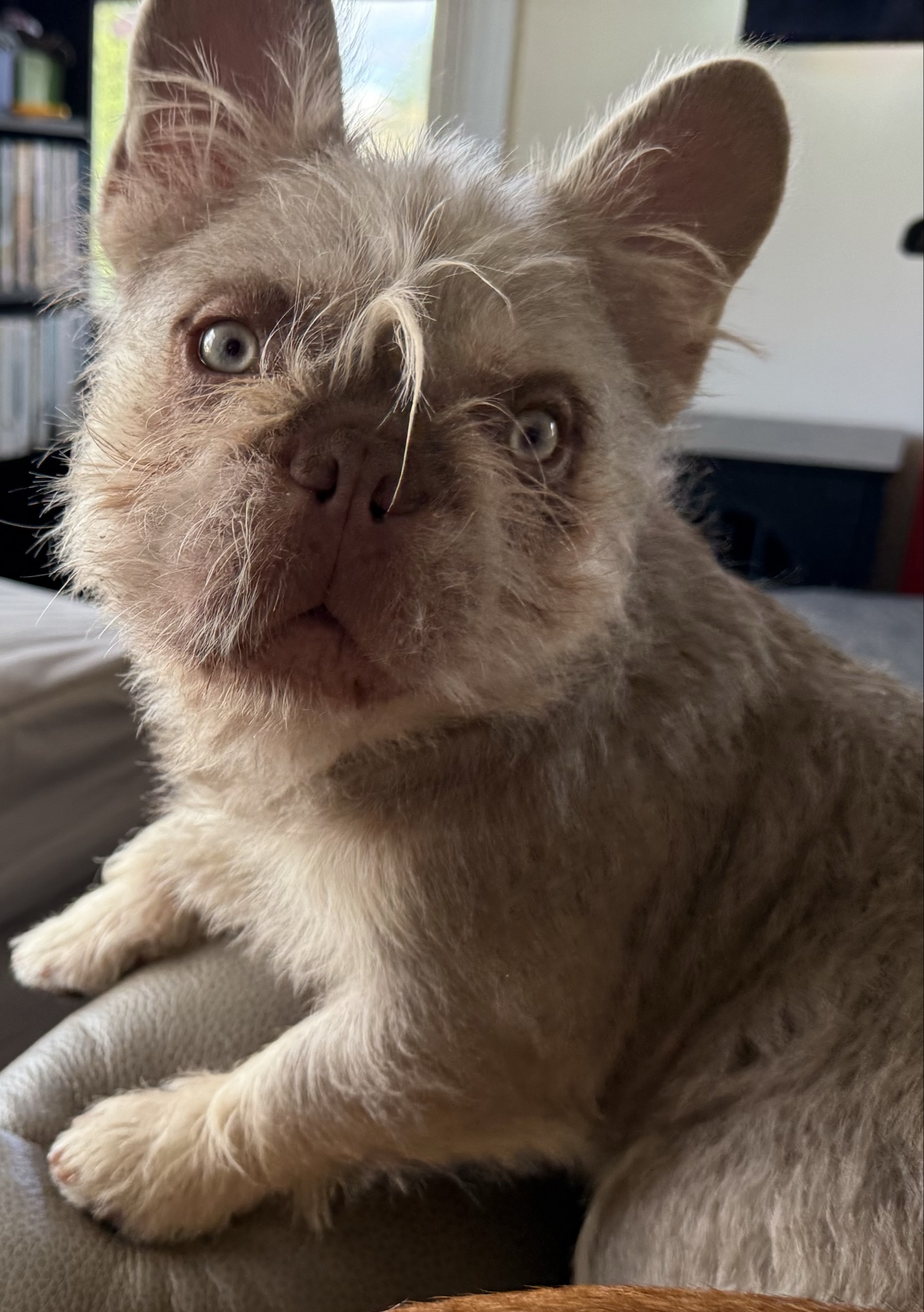
New Shade Isabella tan-point. Furnished. Lh4 fluffy-carrier.
Twenty pounds at one year. A furnishing-driven curl.

Opening for very limited stud service Q1 2027. Chilled and frozen. Approved breeders only. Final fee published after Animal Genetics second-lab verification completes.

The five traits

What he is, in plain English.

New Shade Isabella tan-point

Homozygous dilute (dd), traditional chocolate expressed (bb), testable cocoa expressed (co/co), tan-pointed at A locus (aᵗa). All four recessives, in the same dog, on purpose. Silver-blue eyes that read platinum in natural light. This is the color exotic programs spend a decade trying to build toward.

Furnished

FI at RSPO2 — furnishings is a dominant trait, meaning he expresses it visibly and will pass furnished puppies to 50% of a litter bred to an unfurnished dam, and to 100% bred to another furnished dog. This is a visible face-and-expression trait, not a carrier state.

Lh4 fluffy-carrier

Embark returned ShLh at FGF5 — and, critically, resolved the sublocus: his long-hair copy sits at Lh4, the French-Bulldog-specific rare long-hair variant. Not the common Lh1 marker most breeders test to. Bred to a fluffy dam or another Lh-variant carrier, roughly half his litter will be visual fluffies. See the Lh4 section and the curl section below.

Recessive-red carrier (Ee1)

He carries one copy of the e1 recessive-red allele at the E locus (MC1R). It doesn't express on him — his tan-point pattern shows through as normal — but he passes it to ~50% of his puppies. Bred to another e-carrier dam, ~25% of the litter will be visual recessive red (cream to red coat with brown pigment on the nose, eye rims, and pads). Named up front so no pairing is a surprise at whelp. See the outcomes section for the pairing math.

Twenty pounds. One year old.

Extreme short-back structure, tight to the ground. The small-body genetics families ask for and preservation programs need. He is the male we built this program around.

The part I said I'd publish either way

His coat is three times as long as my visual-fluffy dam's. Embark's expanded panel explains why.

Isabel — one of my dams — is a visual fluffy. LhLh. Homozygous long-hair, common variant. She expresses it. Mouse tested as ShLh — a single fluffy carrier, expected to be short-coated. His coat is currently three times as long as hers.

When I first got Embark's short-form result, that didn't add up on paper. I said publicly I was running him through a second lab. His expanded Embark report has since resolved it, and the answer is more interesting than "the test missed something."

Embark reports his FGF5 coat-length gene across four subloci: Lh1, Lh2, Lh3, and Lh4. Mouse is ShSh at Lh1, Lh2, and Lh3 — the three common long-hair variants. He is ShLh at Lh4, the rare variant Embark documents as appearing in the Afghan Hound, Eurasier, and French Bulldog.

That is the exact French-Bulldog-specific long-hair copy I suspected. He is not carrying the common fluffy allele. He is carrying the uncommon one, which is under-represented in most Frenchie testing because it isn't the primary marker the shortened panels focus on. His coat length — longer than a typical heterozygous carrier of the common Lh1 marker — is consistent with Lh4 expression in a furnished dog.

What it doesn't do: make him a visual fluffy on his own. He is one copy, at one sublocus. He passes it to roughly half his puppies. Bred to a dam carrying any Lh variant — including Isabel — the expected result is ~25% visual fluffies in the litter, and the fluffies from that pairing are likely to be the Lh4 phenotype specifically.

This is the second-lab verification landing where I said it would. It is not what I would have written if I were trying to sell a story; it is what the report says.
The trait, explained honestly

The curl. And where it's actually coming from.

His coat is not just long. It is curling. The wave first showed up along his neck and hindquarters as his adult coat came in, and it has kept defining itself week to week.

When I first wrote about this, I framed the curl as a possible KRT71 result — the classic curl gene, the one behind Poodle and Portuguese Water Dog coats. His expanded Embark panel came back and gave a clearer answer than that: KRT71 = CC. He does not carry the ancestral T-allele curl. Which means the curl I'm seeing isn't the Poodle mechanism. So what is it?

Embark's own KRT71 write-up spells it out. Quoting directly:

“Dogs with two copies of the ancestral C allele are likely to have a straight coat, but there are other factors that can cause a curly coat, for example if they [have] at least one F allele for the Furnishings (RSPO2) gene then they are likely to have a curly coat.”

Mouse is FI at RSPO2 — furnished. That, combined with his Lh4 long-hair copy at FGF5, is what's producing the wave. It's a real, inheritable, documented mechanism. It's just a different gene doing the work than I initially assumed.

What this changes for a breeder considering the pairing:

What actually gets passed

  • Furnishings (RSPO2): ~50% of puppies to an unfurnished dam, ~100% to another furnished dog. Dominant — one copy expresses.
  • Lh4 long-hair variant (FGF5): ~50% of puppies inherit his copy. Recessive — needs two copies to show as visual fluffy.
  • The visible curl: tracks with furnishings + long-hair. Puppies who inherit both are the ones expected to show the wave.

The pairing that produces the phenotype

  • Furnished dam + fluffy-carrier or visual-fluffy dam is where the wavy-coated furnished puppies live.
  • Bred to Isabel (LhLh, unfurnished), the litter should throw ~50% furnished, ~50% visual fluffies, and ~25% both — the profile most likely to show the coat effect at maturity.
  • Bred to a straight-coated, short-coated, unfurnished standard dam, the puppies read as ordinary Frenchies phenotypically and carry the interesting genetics forward for the next generation.

What I won't claim

  • He is not a KRT71 curl carrier. I initially thought the answer might be there. The panel says otherwise, and I'm not going to charge for a genotype he doesn't have.
  • The curl is a phenotypic expression of furnishings + Lh4 in an individual dog. Not every furnished, Lh4-carrying puppy from him will curl the same way — phenotype expression varies with coat length, texture, and finish.
  • What I will say: the mechanism is documented, the paperwork now supports it, and I'll publish the actual coat photos of any confirmed litter so future breeders can see how it expressed.

Same rule I stated when I first opened the page: results get published either way, and the waitlist sees them before the public does. Here they are. The dog is different than I first framed him. He is also, on balance, more interesting than the first version of this page said — because the mechanism is now identifiable, not speculative.

The other thing people notice up close

The banding. What it is, and why it isn't merle.

Each individual hair on Mouse carries more than one color along its length — a lighter section, then a darker section, then lighter again. Up close it reads like a soft, shifting pattern that some people mistake for merle. It isn't. It's tan-point banding expressing through his stacked dilute coat, and it's exactly what his DNA says it should be.

Here's the mechanism, in the order the pieces come together on him:

Step one — the A locus is talking

Mouse is aᵗa at the A locus (tan-point) and kyky at K locus. That means his A locus is not overridden. It is actively switching pigment on and off inside each hair follicle as the hair grows — dark pigment, then light, then dark again. That switching mechanism is what produces banding on the hair shaft.

In a dominant-black dog (KBky or KBKB), the A locus is silenced and hairs grow in solid. In Mouse, the A locus is doing its job, so each hair is banded from root to tip.

Step two — stacked dilution makes the bands visible

The banding is always there in a tan-point coat. On most dogs it's subtle. On Mouse it reads clearly, because his darkest pigment isn't very dark:

  • Diluted (dd) — no full-strength black; the dark bands come in as gray/silver-brown
  • Chocolate-expressed (bb) — no black pigment at all, only brown
  • Cocoa-expressed (coco) — the brown is lightened further to the warm New Shade Isabella tone

The contrast between dark section and light section of each hair reads more visibly against a paler baseline than it would on a saturated black dog. You are seeing the tan-point banding mechanism, photographed through a filter of stacked dilution.

Step three — furnishings + Lh4 give you longer hairs to see it on

The longer an individual hair shaft, the more of the banding sequence is visible per hair. His furnished coat plus the Lh4 long-hair copy at FGF5 gives him longer individual hairs than a smooth-coated standard Frenchie. You are literally seeing more of the banding pattern per strand.

What it isn't

  • Not merle. Embark returned mm — no merle alleles detected. Merle produces patches of diluted pigment across the coat, not banding along the length of a single hair.
  • Not sable or agouti. His A locus is confirmed aᵗa (tan-point). Not aʸ (fawn sable), not aw (wolf sable/agouti).
  • Not roan or ticking. Embark returned rr at R locus — no roan pattern.
  • Not a testing gap. His expanded panel resolved the coat questions people usually save for a second lab. What you see on him is documented by the paperwork, not in spite of it.

The short version, if you're describing him to another breeder: tan-point banding + stacked dilute pigment + long furnished coat. That's the look. It's a real phenotype, not an artifact — and it's what a dilute New Shade Isabella tan-point coat is supposed to look like when you also stack furnishings and a long-hair copy onto the same dog.

If you're a breeder

What his puppies will be.

Bred to a standard, unfurnished, short-coat, non-dilute dam

  • 50% furnished, 50% unfurnished
  • 100% chocolate-carrier (b) & cocoa-carrier (co)
  • 100% dilute-carrier (d)
  • 100% tan-point-carrier (aᵗ)
  • ~50% Lh4 long-hair carrier
  • ~50% recessive-red carrier (e1)
  • All puppies visibly standard color; the value is in what they carry forward to the next generation.

Bred to a fluffy dilute chocolate dam (a matching-stack dam)

  • Chance of visual New Shade Isabella tan-point puppies in the litter
  • ~25–50% visual fluffies, depending on the dam's Lh1/Lh2/Lh3/Lh4 sublocus profile
  • 50% furnished
  • Where the six-figure litters live.

Bred to a recessive-red-carrying dam (Ee or ee)

  • Mouse is Ee1 — he carries one copy of recessive red. It doesn't express on him, but he passes it.
  • Bred to an Ee dam: ~25% of puppies express as solid cream/red with brown pigment on the nose, eye rims, and pads.
  • Bred to an ee (solid red) dam: ~50% express recessive red.
  • This is a real pairing consideration worth naming up front, not a surprise at whelp.

Bred to a merle-carrying dam

  • Not accepted. Mouse tests clean at merle (mm confirmed by Embark), and I'm keeping that clean for the program.
  • Merle-to-merle risk is homozygous double-merle. I won't be the male on the other side of a merle pairing regardless of Mouse's own status.

What Embark has resolved, and what the second lab is still confirming

The verification plan.

When I first opened this page, several of the coat questions were sitting in "pending second-lab retest" status. Embark's expanded panel came back and answered most of them directly. Here is where each stands now, and what the Animal Genetics run is still doing.

  • FGF5 sublocus resolution — RESOLVED. Embark's expanded panel reported all four subloci (Lh1, Lh2, Lh3, Lh4). Mouse is ShLh at Lh4 specifically — the French-Bulldog-documented long-hair variant. See the Lh4 section.
  • KRT71 curl test — RESOLVED. Embark returned CC. He does not carry the ancestral T-allele curl. The visible curl on him is furnishings-driven (RSPO2 + Lh4), which Embark's own KRT71 write-up describes as a documented mechanism. See the curl section.
  • Merle test — RESOLVED. Embark returned mm. No merle alleles detected. Merle-carrying dams are still not accepted for pairings on principle — see the outcome section above.
  • Animal Genetics second-lab confirmation — IN PROGRESS. A confirmatory cross-check on the four coat-color loci doing the most visual work (B, D, cocoa, and A). Not because I doubt the Embark call — the expanded panel is thorough — but because a second lab on a foundation sire is program hygiene, and Embark itself recommends confirmatory testing before breeding decisions.

AG confirmation results will be posted on this page when they come in. Anyone on the waitlist will receive them by email before public posting, so you have a chance to reconsider your reservation with the full information in front of you before I set a final fee.

Terms

How this works.

Timeline

Opening for stud service Q1 2027. Chilled and frozen semen available.

Volume

Three approved dams for the 2027 season. Not everyone. Not many. The door will open on my terms.

Waitlist deposit

$1,500 — holds your place in the queue and applies to the stud fee.

Fully refundable

If any coat call materially changes at the Animal Genetics second-lab confirmation, or if you withdraw before the final fee is published, your deposit is refunded in full. No questions.

Final stud fee

Published after AG second-lab confirmation completes. The Embark expanded panel has already resolved the coat questions; AG is the confirmatory cross-check, and the fee gets set once that lands on the same call.

Payment structure

Deposit at waitlist entry. Balance of fee due after confirmed pregnancy at 28–30 days. Live-guarantee terms in the contract.

Who I'll work with

The approval criteria.

Mouse is not a stud you book by clicking a button. Here is what I need from you before I say yes to a pairing:

  1. A DNA-tested dam. Embark or Animal Genetics — full panel, shared with me before any commitment.
  2. An established program. Minimum two completed litters, or a mentor breeder who will vouch for your practices in writing.
  3. A written single-use contract. No straw resale. No re-selling to third-party breeders. One pairing, one dam, one booking.
  4. My approval on the specific pairing. I want to see the dam — her DNA, her photos, her recent litters — before I green-light a collection. This is the pairing conversation, not a transaction.
  5. No merle-carrying dams. Mouse is confirmed mm; the restriction is a program-hygiene rule, not a status question.

Very limited release

Join the stud waitlist.

Three slots. Deposit-secured. Fully refundable. Message me with your program details and your dam's information, and I'll be in touch personally.

Or email hello@maisondebrumebulldogs.com directly with the subject line "Stud waitlist — Moussimo".

How we test See available puppies